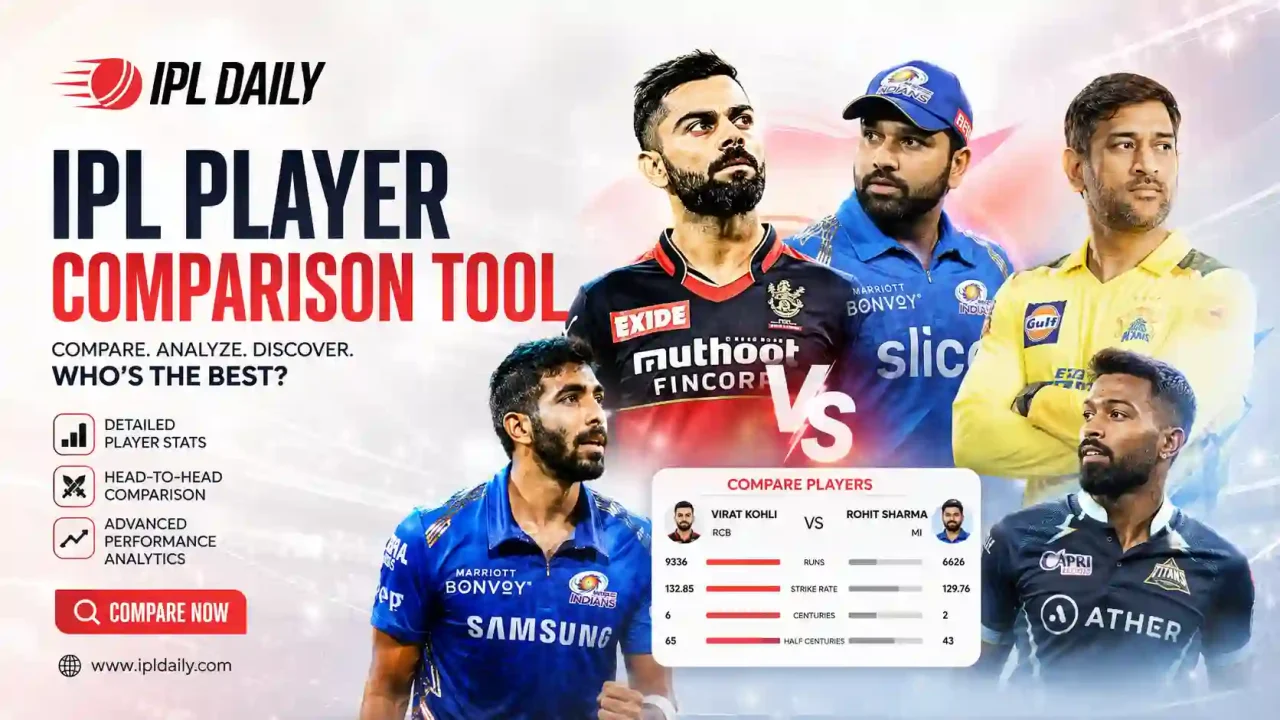
Every cricket argument eventually becomes a stats argument. This free IPL player comparison tool settles the numbers side of it: pick any two players and see their career IPL records side by side, from runs, average and strike rate to wickets and economy, with a clear marker showing who leads each category. Use it to test the great debates or to size up two players you are picking between.
Quick Answer: How the Comparison Works
Pick two players from the dropdowns and the tool lines up their career IPL stats head to head. Batters are compared on matches, runs, average, strike rate, hundreds, fifties and highest score; bowlers on wickets, economy, average and best figures. A green tick marks the player who leads each metric, and a verdict line tallies who comes out ahead. Where a full head-to-head article exists, the tool links to it.
IPL Player Comparison Tool
For the all-time context behind these numbers, see the most runs in IPL history leaderboard and our complete IPL records page. Want a single player’s full story? Open any profile, such as Virat Kohli or MS Dhoni.
How to read the comparison
The tool is built to be glanceable. Once you choose two players, it shows their total matches, then a batting block, then a bowling block where either player has bowled. Within each row the better figure is highlighted with a green tick, so you can see at a glance who leads runs, who strikes faster, and who is more economical.
The direction matters by metric. For batting, higher is better across runs, average, strike rate, hundreds, fifties and highest score. For bowling it flips: a lower economy, a lower bowling average and a lower strike rate are the stronger numbers, while more wickets is better. The verdict line under the table simply counts who leads more categories. One deliberate design choice: when you compare players of different roles, such as a top-order batter against a frontline bowler, the tool does not force a single winner. It shows the batting and bowling sections separately so each player’s real strength is visible rather than buried in a misleading total.
The comparisons fans argue about most
Some matchups carry more weight than others, and the tool is built to feed straight into them. The biggest is MS Dhoni vs Virat Kohli: Kohli owns the batting ledger as the league’s leading run-scorer on 9,336, while Dhoni’s case is built on five titles and the most respected finishing and captaincy record the IPL has seen. The numbers and the trophies pull in different directions, which is exactly why the debate never ends. The other classic is Virat Kohli vs Rohit Sharma, the run machine against the most successful captain in IPL history.
The point of the tool is that you are not limited to the famous pairs. Line up two young top-order batters you are weighing in a fantasy draft, put a modern quick next to a spin legend, or test whether a player you rate actually has the record to back it. The marquee names are where the arguments start, but the interesting answers are often in the matchups nobody has written up yet.
A stat comparison is a starting point, not a verdict, and the honest version of this tool says so out loud. Numbers cannot see that one player opened for ten years while another finished at number seven, or that one batted in the powerplay era and another through the low-scoring 2010s. When the tool says a player leads five of six batting metrics, that is a fact worth knowing, but the why behind it is where the real discussion lives.
What I find it genuinely useful for is cutting through recency bias. A player who looked ordinary in one bad season often has a career record that tells a completely different story, and lining two players up flattens the noise of the last few weeks into the shape of an actual career. Start with the table, then go read the full all-time run list to see where both names really sit.
IPL Player Comparison FAQs
What is the IPL player comparison tool?
It is a free tool that compares any two IPL players’ career statistics side by side – matches, runs, average, strike rate, hundreds, fifties and highest score for batters, plus wickets, economy, average and best figures for bowlers. It highlights which player leads each metric and links to the full head-to-head where one exists.
Which players can I compare?
All the major IPL names we profile, including batters, wicketkeeper-batters, all-rounders and bowlers, across different eras. Just pick two from the dropdowns to see the comparison.
How current are the stats and where do they come from?
Career IPL stats are sourced from ESPNcricinfo and the official IPL site and are updated at the end of each season, so the numbers reflect figures through the most recent completed IPL.
Can I compare a batter with a bowler?
Yes. The tool shows batting and bowling in separate sections, so when you compare players of different roles you can see each one’s strength rather than a single misleading overall number.
Who has scored the most runs in IPL history?
Virat Kohli is the IPL’s leading run-scorer with 9,336 runs, all for Royal Challengers Bengaluru. The comparison tool lets you line up any player against him to see how the rest measure up across matches, average and strike rate.
Does the tool decide who is the better player?
No. It is a statistical comparison that tallies which player leads more metrics, but it does not account for era, role, batting position or match situation. Treat it as a data starting point for the debate, not the final word.
Bottom line
The IPL player comparison tool turns the endless who-is-better debate into something you can actually see: two careers, side by side, with the leader in every category marked. Use it as the opening move in any argument, then back it up with the full IPL records and the all-time run list. And if you want the match-situation version of cricket maths, try our IPL NRR calculator.